The short answer: the container is a development variable, not a finishing touch
Packaging looks like the last decision in a project, but in development it is a condition that has to be assessed together with the formulation. Korea's Ministry of Food and Drug Safety (MFDS) guideline on cosmetic stability testing states that stability testing is carried out under conditions that can assure the physical, chemical and microbiological stability of the cosmetic and the compatibility between the contents and the container, under appropriate storage, transport and use conditions. If the container is not fixed, some checks simply cannot be completed.
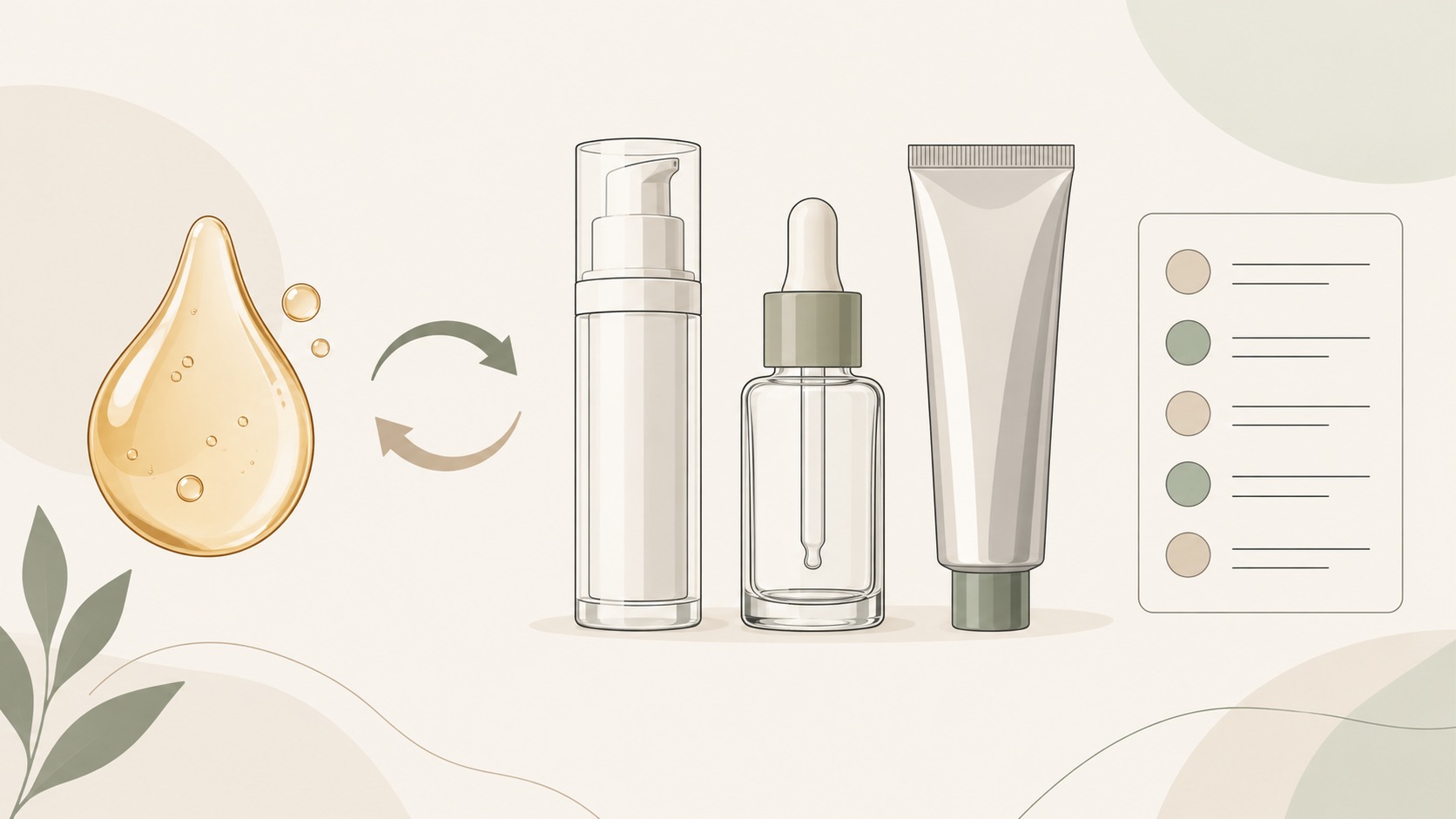
Concept illustration of the interaction between contents and container. It is not a photograph of EVAS products, facilities or testing.
1. Why container compatibility is its own test item
The same MFDS guideline lists a container compatibility test among the test items for long-term stability testing and accelerated testing, described as an evaluation of the interaction between the product and the container, including absorption of the product by the container, corrosion, and chemical reaction.
A container is not just a vessel. Based on the guideline's own wording, there are at least three directions of interaction to consider.
- Absorption: the container can absorb components of the formulation.
- Corrosion: the formulation can affect the container material. As an example of freeze-thaw observation in severe testing, the guideline names corrosion of the internal lacquer of aluminium tubes.
- Chemical reaction: the contents and the container material can react with each other.
The guideline also includes container compatibility inside its definitions of long-term stability testing and accelerated testing. In other words, the container is a variable that affects the result, not a shell applied after testing is finished.
Note: this document is a Korean "civil petitioner guidance" note. MFDS states explicitly that it does not carry external legal force and is not a set of mandatory obligations. Read it as an industry reference for designing tests, not as law.
2. What happens to the schedule when packaging is decided late
For long-term stability testing, the guideline advises selecting lots that use the same formula, dosage form and packaging container as the product to be distributed on the market, and states that testing three or more lots is the principle, while allowing an exception where the difference is judged not to affect stability. The test period is stated as six months or longer in principle, adjustable according to the characteristics of the cosmetic.
Put together: if testing is designed the way the guideline describes, it can only begin once the product is filled into the same container that will be sold. Changing the container later may mean revisiting work that has already been done.
So when you build a launch timeline, anchor it to the date the packaging specification is fixed, not the date the packaging design is approved. Colour, printing and finishing can often be decided later. Material, structure, fill size and dispensing mechanism sit closer to the decisions that have to be made early.
The actual test items, conditions and duration depend on the product type and the distribution plan. This article explains general criteria; it does not define a test plan for a specific product.
3. The container format changes what has to be checked
Container format is not only a matter of taste. It changes the list of things to verify. Using the guideline as the reference:
Does it require post-opening stability testing?
The guideline defines post-opening stability testing as long-term confirmation of physical, chemical and microbiological stability and container compatibility, in order to set a usage period that accounts for contamination that can occur while the product is in use. It then states that products in containers that cannot be opened (such as sprays) and single-use products do not need post-opening stability testing.
A jar that the user reaches into and a format that dispenses without being opened therefore are not comparable on feel and cost alone. Ask which checks each option brings with it.
Is the product exposed to light in its packaging?
Under severe testing, the guideline states that cosmetics packaged in a state where the product can be exposed to light are subject to photostability testing. If you choose clear glass or a transparent tube so the formulation is visible, photostability enters the review. If an opaque container or an outer carton is an option, that difference is worth comparing directly.
Will it survive transport and storage?
The guideline describes mechanical shock testing as being used to investigate the possibility of damage to the cosmetic or the packaging during transport, and lists packaging problems under freeze-thaw observation, including loss or creasing of labelled information, breakage and denting. If your distribution route is long or involves large temperature swings, raise this early.
4. Separate guidance from legal obligation
Everything above is guidance. Statutory requirements are a different category. For cosmetics manufactured and distributed in Korea, the following apply.
Four items that must appear on the primary packaging
Article 10(2) of the Korean Cosmetics Act requires that, for a cosmetic whose primary packaging is placed inside secondary packaging, the primary packaging bears:
- the name of the cosmetic
- the trade name of the business operator
- the manufacturing number
- the use-by date or the period after opening
The same paragraph provides an exception for cosmetics prescribed by Ordinance of the Prime Minister, such as solid soap, where the consumer removes the primary packaging before use.
In practice this rule feeds straight back into container selection. If you are considering a small ampoule, a slim stick or a strongly curved container, confirm first that there is enough legible surface and a workable printing method for those four items. Discovering a shortage of label area after the design is locked means reopening the container decision.
Is it a safety-container item?
Article 18(1) of the Enforcement Rule of the Cosmetics Act lists the items that must use safety containers and packaging: nail enamel remover and nail polish remover containing acetone; non-emulsion liquid products such as children's oils containing 10 percent or more hydrocarbons per individual package with a kinematic viscosity of 21 centistokes or less at 40 degrees Celsius; and liquid products containing 5 percent or more methyl salicylate per individual package.
The same paragraph excludes single-use products, spray containers operated by a pump or trigger at the container opening, and compressed spray containers such as aerosols. Paragraph 2 requires that such packaging be difficult for children under five years old to open, while not being difficult for an adult to open.
Whether a product in development falls into these categories depends on its formula and physical properties, so it is worth checking while the formulation direction is still being set.
The rules above are Korean statutes and Korean regulatory guidance. If you plan to export, the labelling and packaging requirements of the destination market must be confirmed separately. This article does not cover requirements in other countries.
5. Six lines for your packaging brief
Fill these in before a consultation, marking clearly what is fixed and what is still open.
- Formulation and properties: dosage form, approximate viscosity, whether it is an emulsion, whether fragrance or oils are used
- Fill size and use: fill volume, amount per use, and whether it is dispensed by hand, with a tool, or directly
- Container candidates: material and structure (airless, pump, dropper, tube, jar) and which of these can flex
- Labelling plan: where and how the four primary-packaging items will appear, and whether secondary packaging is used
- Distribution conditions: markets and channels, routes with large temperature swings, expected storage period
- Non-negotiables: the appearance, sensory result or timing the brand must keep
When you send the inquiry, add: "Please tell us which container options are feasible for this formulation, and which checks change depending on the container."
If the product direction is still forming, start with the product-brief guide. For quantity conditions, read the small-batch and MOQ guide. Formulation directions can be compared in the formulation library, which holds development concepts rather than confirmed formulas or ready-to-produce inventory.
Frequently asked questions
When does the container have to be fixed?
Before stability testing begins, if testing is designed the way the MFDS guideline describes. The guideline advises using the same formula, dosage form and packaging container as the product that will be distributed. Colour and printing can follow later; material, structure and fill size are safer to settle early.
Does choosing an existing stock container reduce the checks?
It can shorten container development, but it does not replace the assessment of compatibility between contents and container. Container compatibility looks at one specific formulation in one specific container.
Jar or airless: which is better?
There is no general answer, but the required checks differ. The guideline states that products in containers that cannot be opened and single-use products do not need post-opening stability testing, so compare the use pattern, the formulation and the distribution plan together.
Does this mean EVAS performs all of these tests?
No. This article explains general review items based on published guidance and statutes. Which items are carried out, and under what conditions, is agreed per project after the product and distribution plan are reviewed.
Do the same rules apply to export products?
This article is based only on Korean statutes and MFDS guidance. Labelling and packaging requirements for each destination market must be confirmed separately.
Review the formulation and the container together
EVAS connects product planning, design, research, manufacturing, logistics and brand content in-house. Look through the development process, then send the six lines above through a development inquiry. The scope and terms of an individual project are confirmed through consultation.
Sources
- Korea MFDS, Guidelines on Stability Testing of Cosmetic Products (Guidance No. 0332-01) (accessed 2026-09-15) ↗
- Cosmetics Act of Korea, Article 10 (Korea Law Information Center, effective 2026-04-02) (accessed 2026-09-15) ↗
- Enforcement Rule of the Cosmetics Act of Korea, Article 18 (Korea Law Information Center, effective 2026-04-02) (accessed 2026-09-15) ↗