The short answer: outsourcing manufacturing does not move every duty
The most common misunderstanding in a cosmetics development consultation is that once manufacturing is outsourced, quality and paperwork belong entirely to the factory. Korean law does not work that way. The Cosmetics Act of Korea separates cosmetics manufacturing business from cosmetics responsible distribution business, registers them separately, and writes a separate list of duties for each. A brand that puts a product on the market is usually the responsible distributor, and some obligations sit only there.
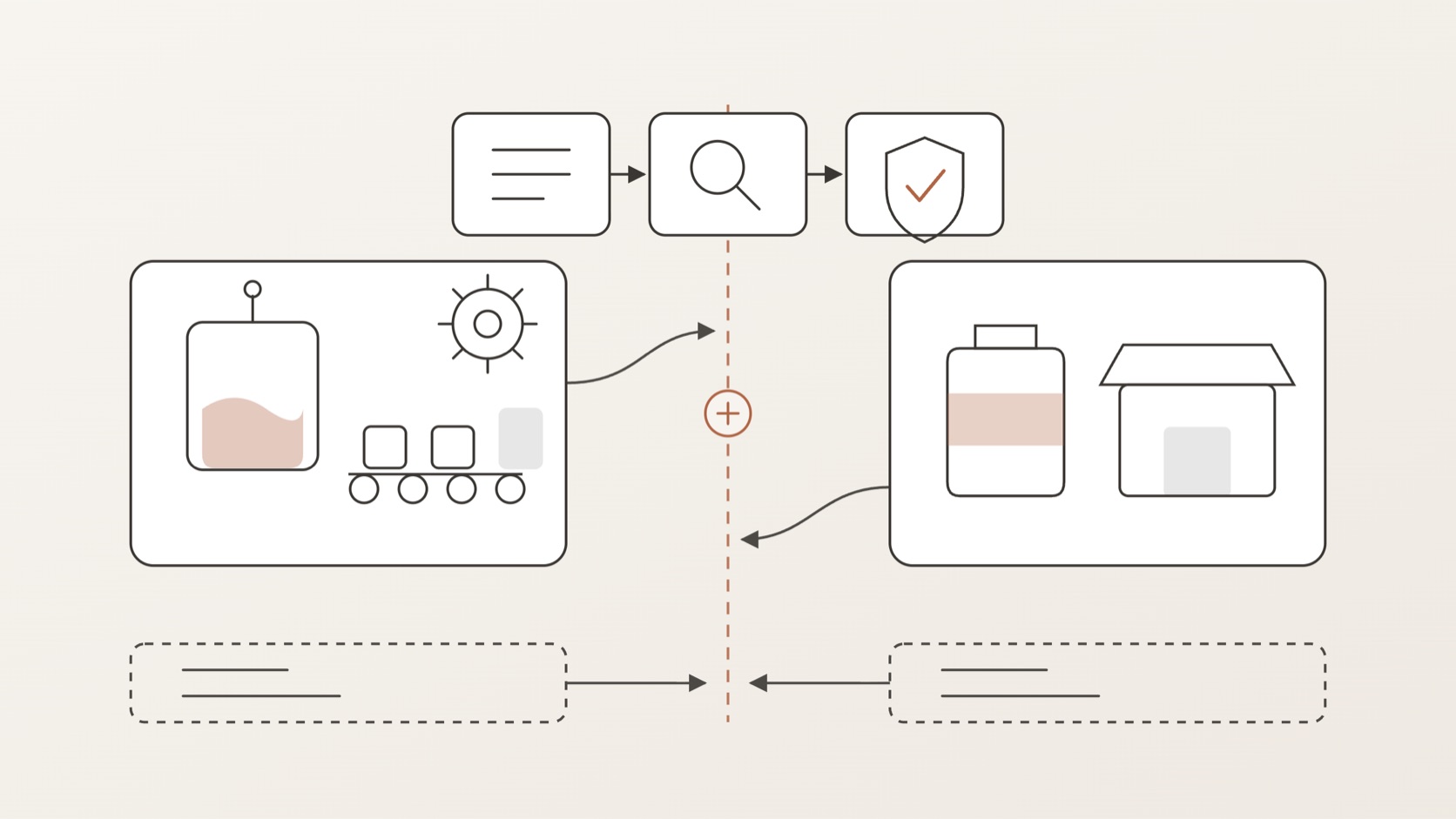
A concept diagram explaining where the duties of the manufacturing side and the brand side separate and where they meet again. It is not a photograph of EVAS facilities, products or documents.
1. Two registrations, two different businesses
Article 2 of the Cosmetics Act distinguishes the two businesses as follows.
- Subparagraph 10, cosmetics manufacturing business: the business of manufacturing all or part of a cosmetic, excluding processes that consist only of secondary packaging or labelling.
- Subparagraph 11, cosmetics responsible distribution business: the business of distributing and selling cosmetics while managing their quality and safety, or of brokering and supplying them for import agency transactions.
Article 3(1) requires anyone intending to run either business to register with the Minister of Food and Drug Safety, and the same applies when changing important registered particulars specified by Ordinance of the Prime Minister.
The conditions differ. Article 3(2) requires the facility standards specified by Ordinance of the Prime Minister for manufacturing registration, with a proviso allowing part of the facilities to be omitted in cases specified by ordinance, such as manufacturing only part of the process. Article 6(1) of the Enforcement Rule lists those facilities as a work area, a storage area, a testing laboratory, and the facilities and instruments needed for quality testing; Article 6(2) sets out the exemptions for partial-process manufacturing and for outsourcing quality testing to a Health and Environment Research Institute, a manufacturer that has such a laboratory, a cosmetics testing and inspection body, or the Korea Pharmaceutical Traders Association.
Article 3(3), by contrast, requires a responsible distributor to meet the standards for quality control and post-distribution safety control, and to appoint a responsible distribution manager who can manage them. Not facilities, but standards and a person.
2. Who can be the responsible distribution manager, and what do they do
Article 8(1) of the Enforcement Rule lists who can serve as the responsible distribution manager that a responsible distributor must appoint. Distributors registered under Article 2, subparagraph 2(d) of the Enforcement Decree, that is, e-commerce import agency brokering businesses, are outside that requirement. The qualifications are: doctors and pharmacists; people with a bachelor's degree or higher in science and engineering or in fields such as cosmetic science; people with an associate degree in a cosmetics-related field plus at least one year in cosmetics manufacturing or quality control; people who completed a specialised training course notified by the Minister of Food and Drug Safety, for notified items only; people who passed the customised cosmetics preparation manager examination; and people with at least two years of experience in cosmetics manufacturing or quality control.
Article 8(2) defines three duties.
- Quality control work under the quality control standards in Annex 1.
- Safety assurance work under the post-distribution safety control standards in Annex 2.
- Managing and supervising the manufacturer with respect to the testing, inspection or verification required from the receipt of raw and other materials through to the release of finished products.
The third duty deserves attention. The brand does not run the tests itself; supervising whether the manufacturer runs them properly is written as the brand side's job.
Article 8(3) adds a practical accommodation. If the responsible distributor runs a business with ten or fewer full-time employees and the distributor, or the representative of a corporate distributor, personally meets one of the qualifications in Article 8(1), that person may perform the manager's duties, and in that case the business is deemed to have appointed a responsible distribution manager.
Training is mandatory too. Article 5(7) of the Act requires annual training for the responsible distribution manager, and Article 14(1) of the Enforcement Rule splits it into initial and refresher training. Initial training is due within six months of starting the role, but a person who passed the qualifying examination within one year before starting is deemed to have taken it. Refresher training is once a year counted from the date of the initial training, or, where that proviso applies, from the first anniversary of passing the examination.
3. The duty lists are written separately
Article 11(1) of the Enforcement Rule, for manufacturers, includes duties such as:
- Following the guidance, supervision and requests of the responsible distributor under the quality control standards in Annex 1.
- Preparing and keeping the manufacturing control standard document, the product standard document, the manufacturing control record and the quality control record.
- Keeping the manufacturing site, facilities and instruments hygienic and free from contamination so that no harm to public health and hygiene arises.
- Carrying out the testing, inspection or verification required from the receipt of raw and other materials through to the release of finished products.
- Where manufacturing or quality testing is subcontracted, supervising the subcontractor thoroughly and obtaining and maintaining the manufacturing and quality control records.
Article 12, for responsible distributors, includes:
- Complying with the quality control standards in Annex 1.
- Complying with the post-distribution safety control standards in Annex 2.
- Keeping the product standard document and quality control record received from the manufacturer.
- Conducting thorough quality testing for each manufacturing lot before distribution. Testing may be omitted where the manufacturer and the responsible distributor are the same person, or where testing was outsourced to one of the bodies listed in Article 6(2)2 of the Enforcement Rule and a per-lot result exists.
- Where manufacturing is entrusted to a third party, or quality testing is entrusted to a manufacturer under Article 6(2)2(b) of the Enforcement Rule, supervising the subcontractor thoroughly on whether the manufacturing or testing is done properly, obtaining and maintaining the manufacturing and quality control records, and managing the quality of the final product.
Items that apply only to imported products, such as keeping an import control record, sit in the same article separately. The opening text of that article also provides that only some subparagraphs apply to operators registered as import agency brokering businesses. A brand that outsources domestic manufacturing starts with the duties above.
4. CGMP is recommended, not mandatory
Cosmetics Good Manufacturing Practice (CGMP) is often assumed to be a legal requirement. Article 11(2) of the Enforcement Rule states that, in addition to the duties in paragraph 1, the Minister of Food and Drug Safety may recommend that manufacturers comply with the good cosmetics manufacturing practice standards notified by the Minister. Article 11(3) allows the Minister to support compliant manufacturers with technical guidance and training, consulting, and facility improvement.
So the current structure is recommendation and support. Whether a retailer, distribution channel or overseas buyer demands it contractually is a separate question. Keep the legal obligation and the counterparty's commercial requirement as two different checks.
5. Turnkey versus customer-supplied materials: what changes and what does not
Having the manufacturer source all packaging components, or supplying them yourself, changes the shape of a quotation considerably. Who purchases, who carries inventory and defect risk, and where the lead time is fixed all shift. That part is contractual and differs by company.
But something does not shift. Article 11(1) of the Enforcement Rule requires the manufacturer to carry out the testing, inspection or verification needed from the receipt of raw and other materials through to the release of finished products. Who paid for the materials does not remove that item. And under Article 8(2)3, supervising the manufacturer on exactly that chain is the responsible distribution manager's duty.
So even with customer-supplied materials, it is safer to settle the following in the contract and specification in advance.
- The specification and incoming acceptance criteria for supplied materials, and what happens when a lot fails.
- The format and timing for sharing incoming inspection results and records.
- How delays or losses caused by supplied materials are handled.
- When formulation and container compatibility is confirmed. That sequence is covered separately in when to lock the container.
6. How much of the formula and the records can you receive
Article 11(1)6 of the Enforcement Rule requires the manufacturer to submit to the responsible distributor the items necessary for quality control from the documents listed in subparagraph 2 of the same paragraph, namely the manufacturing control standard document, the product standard document, the manufacturing control record and the quality control record. The proviso to that subparagraph allows two exceptions: submission may be omitted where the manufacturer and the responsible distributor are the same person, and where the manufacturer designs, develops and produces the product and the information is a trade secret under a mutual agreement, to the extent this does not affect quality and safety control.
Article 12(3) separately requires the responsible distributor to keep the product standard document and quality control record received from the manufacturer.
In other words, it is neither a structure where every document is handed over unconditionally nor one where nothing is. It depends on the development model and on what the contract says. Agreeing the document scope while the development model is being decided means less friction later.
7. What has to be finished before distribution
- Raw material list report: the second sentence of Article 5(5) of the Act requires the report on the list of raw materials to be made before the cosmetic is distributed and sold, and Article 13(2) of the Enforcement Rule applies the same timing when a reported list changes. Article 13(3) sets a separate exception for importers who file a standard customs clearance report as an electronic trade document, so import cases should be read against the original text.
- Per-lot quality testing: Article 12(5) of the Enforcement Rule requires thorough quality testing for each manufacturing lot before distribution, subject to the exemptions noted above.
- Labelling: Article 10(1) of the Act sets out what must appear on the outer packaging of a cosmetic that consists only of a primary container, and on the outer packaging where secondary packaging is added. The items include the product name, the trade name and address of the business operator, all ingredients used in manufacturing the product (excluding ingredients specified by ordinance, such as harmless trace ingredients), the volume or weight of the contents, the lot number, the expiry date or period after opening, the price, the functional-cosmetic indication and the precautions for use. The proviso to the same paragraph allows packaging specified by ordinance, such as small-volume packaging, to carry only the product name, the trade name of the responsible distributor and the customised cosmetics seller, the price, the lot number and the expiry date or period after opening. Article 10(2) requires the product name, the trade name of the business operator, the lot number and the expiry date or period after opening on the primary container where secondary packaging is added, with a proviso for cosmetics specified by ordinance, such as solid soap, where the consumer removes the primary container before use.
- Production and import results report: Article 13(1) of the Enforcement Rule requires the previous year's production or import results to be reported through a cosmetics industry association by the end of February each year. Not a launch-day item, but a recurring one the brand carries.
8. Frequently asked questions
Doesn't the manufacturer handle all of this?
Operational support can be designed into a contract. But the duties the law places directly on the responsible distributor do not move by outsourcing alone: complying with Annexes 1 and 2, quality testing per lot before distribution, supervising the subcontractor and keeping the records, reporting the raw material list, and appointing and training the responsible distribution manager.
Do we have to hire a separate responsible distribution manager?
Where the conditions in Article 8(3) of the Enforcement Rule are met, the responsible distributor personally, or the representative in the case of a corporation, may perform the duties and the business is deemed to have appointed a manager. Qualification is judged against each subparagraph of Article 8(1), so it is worth checking the original text directly.
Does a brand also need a manufacturing registration?
There is no blanket answer. The definition in Article 2, subparagraph 10 of the Act covers manufacturing all or part of a cosmetic and excludes processes consisting only of secondary packaging or labelling. Because it depends on which processes you actually perform, it is safer to confirm with the competent authority once the business structure is fixed.
We only plan to export. Is the procedure the same?
Not necessarily. Article 30 of the Act provides that products not sold domestically and intended solely for export may follow the importing country's rules instead of Articles 4, 8 through 12, 14, Article 15 subparagraphs 1 and 5, and Article 16(1)2, (1)3 and (2). Article 3 registration and the Article 5 operator duties are not among the listed exclusions. Destination-market requirements have to be verified separately under that country's rules.
Will EVAS prepare these documents for us?
It depends on the item and the contract scope, so we do not promise this in general terms. Tell us the product and the sales plan and we will start by mapping which parts remain on the brand's side.
9. Next step
EVAS runs planning, design, research, manufacturing, logistics and brand content in-house. If you are preparing a first product, start with our development process and the formula library. At the brief stage, see how to write a clear brief; if volume is the open question, see small-batch planning and MOQ. If you are reviewing claim wording, what changes with a functional claim is also relevant. Send us your situation through contact and we will map it out. More articles are in insights.
10. Sources
Scope is the Republic of Korea. The statutes below were read in the original on the Korea Law Information Center on 17 September 2026. This article summarises published rules as general guidance; decisions on a specific case follow the latest original text and confirmation from the competent authority.
- Cosmetics Act of Korea, Articles 2, 3, 5, 10 and 30, effective 2 April 2026, Act No. 20901 (partially amended 1 April 2025).
- Enforcement Rule of the Cosmetics Act of Korea, Articles 6, 8, 11, 12, 13 and 14, effective 2 April 2026, Ordinance of the Prime Minister No. 2109 (partially amended 31 March 2026).
Sources
- Cosmetics Act of Korea, Articles 2, 3, 5, 10 and 30, effective 2026-04-02, Act No. 20901 (Korea Law Information Center) (accessed 2026-09-17) ↗
- Enforcement Rule of the Cosmetics Act of Korea, Articles 6, 8, 11, 12, 13 and 14, effective 2026-04-02, Ordinance of the Prime Minister No. 2109 (Korea Law Information Center) (accessed 2026-09-17) ↗