The short answer: the legislation does not prescribe one expiry period for all cosmetics
One question comes up in almost every development conversation. How many years should the expiry date say? However, neither the Cosmetics Act of Korea nor its Enforcement Rule prescribes a single number of months or years as the expiry date for all cosmetics. What the legislation fixes is what must appear on the packaging and how it must be written. The value itself is something each product has to establish with evidence.
That evidence is stability data. The Ministry of Food and Drug Safety guideline on stability testing of cosmetic products describes stability testing as testing that evaluates the stability of quality against change over time, in order to establish the storage method and the expiry date of a cosmetic. In other words, the number is established by evaluating the formula, dosage form, container and storage conditions together.
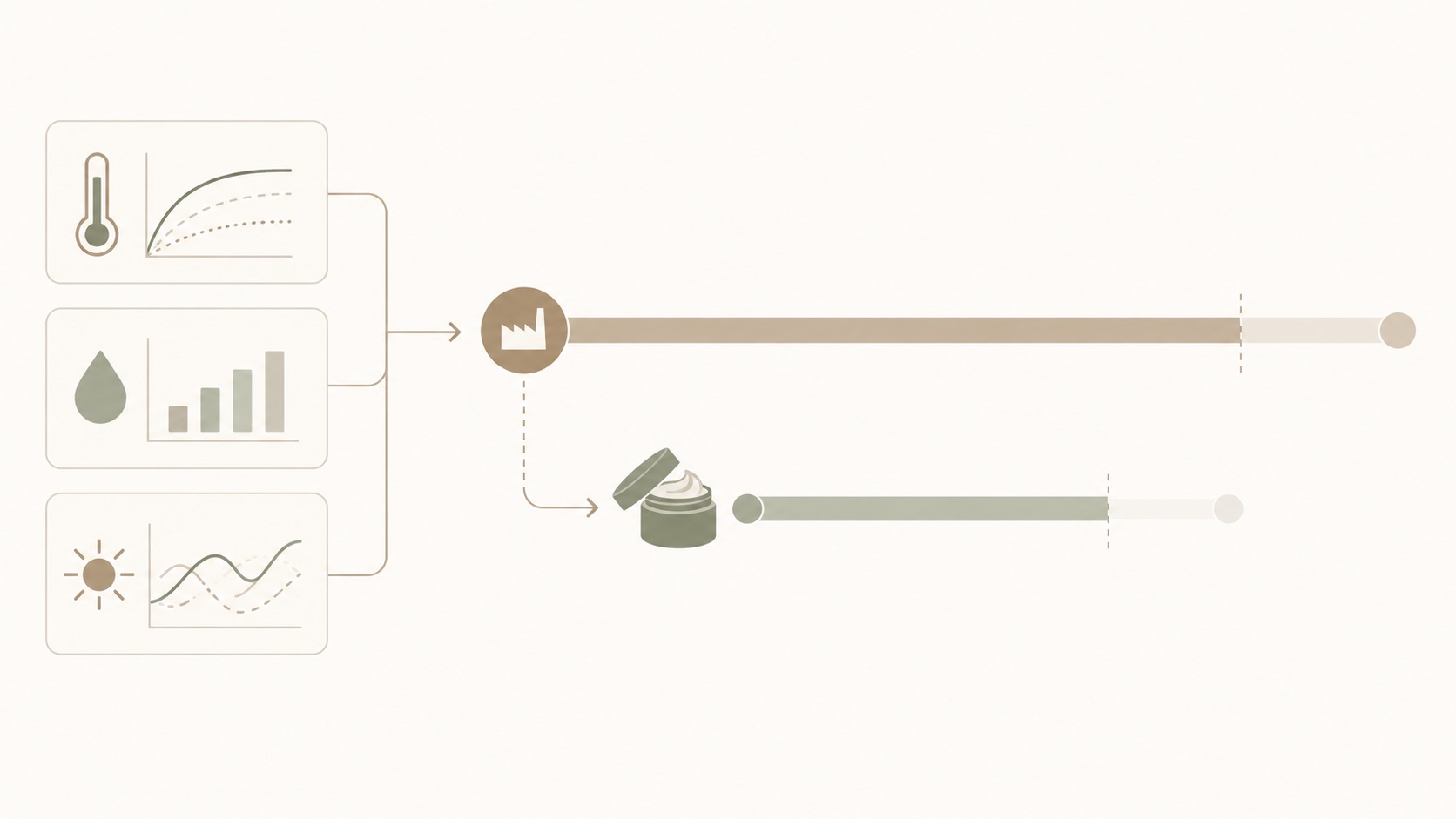
A concept illustration showing that the two printable values start from different reference points and that their length comes from test data. It is not a photograph of EVAS products, facilities or test records.
1. The expiry date and the period after opening are two different values
Article 2, subparagraph 5 of the Cosmetics Act defines the expiry date as the minimum period, counted from the manufacturing date, during which a cosmetic retains its inherent characteristics under appropriate storage conditions and remains suitable for consumer use. The reference point is the manufacturing date.
The same Article contains no separate definition of the period after opening. Instead, that term appears in the provisions on required label information and labelling methods. Article 10(1), subparagraph 6 of the Act lists the expiry date or the period after opening as an item that must be stated. It is a choice between the two.
One condition attaches to that choice. The parenthesis inside the proviso to the part of Article 10(1) other than its subparagraphs states that where the period after opening is stated, the manufacturing date must be indicated alongside it, and adds that the same applies throughout that Article. Choosing the period after opening brings the manufacturing date with it.
2. The guideline explains how stability testing is used to set an expiry date
The nature of the document has to be stated first. The guideline on stability testing of cosmetic products is a non-binding guidance document for petitioners. Its own text says that it has no external legal force, so that despite the phrasing used in the body, it is not something petitioners are required to comply with. It also says that it was written on the basis of the scientific and technical facts and the regulations in force as of September 2011, and may therefore apply differently in light of later amendments and the specific facts of a case. What follows should be read as the method the Ministry of Food and Drug Safety sets out for building supporting data, not as a list of legal duties.
The guideline divides stability testing into four types.
- Long-term preservation testing: testing that confirms physical, chemical and microbiological stability and container suitability over a long period, in order to establish the expiry date under the storage conditions of the cosmetic.
- Accelerated testing: testing that evaluates the effect of short-term accelerated conditions outside the storage conditions of long-term preservation testing on physical, chemical and microbiological stability and container suitability.
- Stress testing: testing that confirms the degradation process and degradation products of a cosmetic under harsh conditions. Temperature variation and extreme conditions, mechanical and physical testing, and photostability are given as examples.
- Post-opening stability testing: testing that confirms physical, chemical and microbiological stability and container suitability over a long period, in order to establish an expiry date that takes account of contamination and similar effects that may occur while the cosmetic is in use.
As the names suggest, the two values you may print come from different tests. The period for an unopened package rests on long-term preservation testing, while the period after opening rests on post-opening stability testing. Accelerated testing is a separate test that evaluates how short-term accelerated conditions outside those storage conditions affect stability and container suitability.
3. The test conditions that collide with a launch schedule
Among the general test conditions the guideline sets out, these are the ones that actually surface in schedule discussions.
- Lot selection: long-term preservation testing uses the same formula, dosage form and packaging container as the product to be distributed on the market, and, as a general rule, is performed on three or more lots. An exception to the three-or-more-lot principle may be made where it is judged that stability will not be affected.
- Storage conditions: temperature, humidity, test duration and measurement points are set with the distribution conditions of the product in mind. As examples, a cosmetic stored at room temperature may be tested at 25±2℃ with 60±5% relative humidity, or at 30±2℃ with 66±5% relative humidity, and a refrigerated cosmetic at 5±3℃.
- Test duration: as a general rule, testing runs for at least six months, although a different duration may be set depending on the characteristics of the cosmetic.
- Measurement points: at the start of the test, then every three months during the first year, every six months up to two years, and once a year after two years.
- Accelerated test conditions: lot selection follows the long-term preservation standard, and the storage temperature is generally 15℃ or more above the designated storage temperature used for long-term preservation testing, with 40±2℃ and 75±5% relative humidity given as the example for a room-temperature cosmetic. As a general rule the test runs for at least six months, but the duration may be adjusted where necessary, with at least three measurements including the start of the test.
The most important point here is the lot-selection condition. Requiring the same formula, dosage form and packaging container as the product to be distributed means that changing the formula or the container after testing has started changes the premise of the data. When a container should be locked is covered separately in when to lock the container.
4. The case where the guideline says post-opening testing is not needed
The guideline lists the test items for post-opening stability testing as the items tested before opening plus microbial limit testing, preservative testing and testing of the active ingredients. It then adds a proviso: products in containers that cannot be opened, such as sprays, and single-use or similar products do not need post-opening stability testing.
Under the guideline, container architecture and the manner of use can change whether post-opening stability testing is treated as necessary. If a spray format or a single-use sachet is on the table, it is worth raising this before the formula is locked.
5. How the value is printed is set out in Attached Table 4
Article 19(7) of the Enforcement Rule provides that the labelling standards and labelling method for cosmetic packaging under Article 10(5) of the Act are as set out in Attached Table 4. Item 6 of that table separates the two values.
- The expiry date must be stated with wording such as expiry date or until, together with the year, month and day, in a way consumers can readily understand. If only the year and month are shown, they must not indicate a date later than the expiry date.
- The period after opening may be stated by combining the words for period after opening with a period expressed in months, or by stating a symbol representing the period after opening together with the period.
Item 5(a) of the same table requires the lot number to be stated so that it is easily distinguishable from the expiry date, or the period after opening, and requires the manufacturing date that must accompany a stated period after opening, or the date of mixing or repackaging in the case of a customised cosmetic, to be stated so that each is distinguishable as well. Attached Table 4 requires the three values to remain readily distinguishable but does not prohibit placing them on the same line. Even on a single line, the engraving or printing has to keep them actually distinguishable.
For a gift set, read item 5(b) and item 6(c) together. On the outer packaging of a set, the expiry date of the constituent cosmetic that expires earliest may be stated alone, with wording that directs the reader to where the others are stated; the period after opening may likewise be stated only for the cosmetic with the oldest manufacturing date, with the same kind of pointer for the rest. The lot number may either be stated for each constituent cosmetic or replaced by a single integrated lot number.
6. A small fill size does not remove this item
The proviso to the part of Article 10(1) of the Act other than its subparagraphs allows packaging specified by ordinance, such as packaging for a cosmetic with a small fill volume, to state only the product name, the trade name of the responsible distributor and of the customised cosmetics seller, the price, the lot number and the expiry date or period after opening.
Article 19(1) of the Enforcement Rule defines that packaging in two categories. The first is packaging for a cosmetic with a fill volume of 10 millilitres or less, or a weight of 10 grams or less, excluding cosmetics that the Minister of Food and Drug Safety designates and publishes as requiring special care in consumer use. The second is packaging for a cosmetic manufactured or imported so that consumers may test or use it in advance when choosing a product or for a similar purpose, rather than for the purpose of sale; under the proviso to the same paragraph, the price in that case means wording such as sample or not for sale.
Even where the list of required items is cut down this far, the expiry date or period after opening stays on it. Article 10(2) of the Act works the same way. Where secondary packaging is added to a primary container, the primary container must state the product name, the trade name of the business operator, the lot number and the expiry date or period after opening, subject to a proviso for cosmetics specified by ordinance, such as solid soaps, where the consumer removes the primary container before use. Article 19(6) of the Enforcement Rule identifies that cosmetic as toilet soap.
The manner of labelling is also constrained. Article 12 of the Act requires the entries under Articles 10 and 11 to be placed where they can be seen more easily than other text, and to be stated accurately in Korean that is easy to read and understand, as prescribed by ordinance, while allowing Chinese characters or a foreign language to be stated alongside. The proviso to Article 21, subparagraph 1 of the Enforcement Rule allows Chinese characters or a foreign language to be added, and allows products for export and similar products to be written in the language of the destination country.
7. Some formulas and registration categories carry a record-keeping duty
Article 12, subparagraph 11 of the Enforcement Rule requires that, for a product containing 0.5 per cent or more of any of the following ingredients, the stability test data for that item be kept for one year from the expiry date of the last manufactured product.
- Retinol (vitamin A) and its derivatives
- Ascorbic acid (vitamin C) and its derivatives
- Tocopherol (vitamin E)
- Peroxide compounds
- Enzymes
A brand should first check whether the ingredient reaches 0.5 per cent, because the retention period above only matters where that provision applies. The scope is limited as well. The parenthesis in the main text of Article 12 provides that, for a person registered for the cosmetics responsible distribution business under Article 2, subparagraph 2(d) of the Enforcement Decree, only subparagraphs 1, 2, 4(a), 4(c), 4(g), 4(j) and 10 apply, so subparagraph 11 does not apply in that case.
Where a product is to be labelled or advertised as one that infants or children may use, the end of the retention period is tied either to the expiry date or to the manufacturing date, depending on which value appears on the primary container. Article 4-2(1) of the Act requires a responsible distributor to prepare and keep product-specific safety data, namely materials explaining the product and its manufacturing method, cosmetic safety assessment data, and data substantiating the efficacy and effect of the product. Article 10-3(2) of the Enforcement Rule splits the retention period in two. Where the primary container states an expiry date, the period runs from the date of the labelling or advertising until one year after the expiry date of the last product manufactured or imported. Where the primary container states a period after opening, it runs from the date of the labelling or advertising until three years after the manufacturing date of the last product manufactured or imported. In both cases the period is counted from the manufacturing date under the lot number for manufactured products, and from the customs clearance date for imported products. Under Article 10-2(1) of the Enforcement Rule, infants are three years old or younger and children are four through thirteen years old, inclusive.
8. Adjusting a printed value later is a separate matter
Article 15, subparagraph 9 of the Act prohibits selling, or manufacturing, importing, storing or displaying for the purpose of sale, a cosmetic whose expiry date or period after opening under Article 10(1), subparagraph 6 has been forged or altered. The same subparagraph states expressly that a manufacturing date indicated alongside falls within that scope. Reworking the date because of inventory or distribution timing is not an available option.
9. What to settle during development
- Decide first whether you are printing an expiry date or a period after opening. The second choice brings the manufacturing date with it.
- Check the container architecture. The guideline states that products in containers that cannot be opened, and single-use or similar products, do not need post-opening stability testing.
- Match the formula, dosage form and packaging container used in testing to the specification you will actually distribute. Later changes disturb the premise of the data.
- Put the test duration and measurement points next to the launch schedule. As a general rule, long-term preservation testing runs for at least six months.
- Check both whether the ingredient reaches 0.5 per cent and whether Article 12, subparagraph 11 applies to your responsible-distributor registration category.
- If labelling or advertising for infants or children is planned, plan the product-specific safety data and its retention period at the same time.
- If there is a gift set or a small-volume package, read the relevant items of Attached Table 4 in advance.
- If the product is for export only, the scope of application may differ, so read Article 30 of the Act together with the rules of the destination country.
10. Frequently asked questions
Do both the expiry date and the period after opening have to be printed?
Article 10(1), subparagraph 6 of the Act is worded as the expiry date or the period after opening, so one of the two is stated. Where the period after opening is stated, however, the manufacturing date must be indicated alongside it.
How many months is normal?
The legislation does not prescribe one number that applies to all cosmetics. Formula, dosage form, container and storage conditions differ product by product, and the guideline explains how the value is established per product through stability testing. EVAS likewise does not promise a general number of months before seeing the item.
Does stability testing have to run for six months?
The guideline sets a general minimum of six months for both long-term preservation testing and accelerated testing, while adding that the former may be set differently depending on the characteristics of the cosmetic and the latter may be adjusted where necessary. The document itself is guidance for petitioners, not a regulation with legal force.
If the container changes, does testing start again?
The lot selection condition in the guideline is the same formula, dosage form and packaging container as the product to be distributed. Once the container changes, that condition no longer holds, so the scope of testing has to be reconsidered in light of how large the change is and what it affects. There is no blanket answer that all testing must be repeated or that none of it has to be.
Do export-only products follow the same labelling rules?
Article 30 of the Cosmetics Act provides that, for a product intended solely for export and not sold domestically, Article 4, Articles 8 through 12, Article 14, Article 15, subparagraphs 1 and 5, Article 16(1), subparagraphs 2 and 3, and Article 16(2) do not apply, and the rules of the importing country may be followed instead. Articles 10 and 12, which govern labelling, fall within that range. The requirements of the importing country have to be checked separately under that country's rules. The scope of this article is the Republic of Korea.
Does working with EVAS include preparing the stability file?
That depends on the item and the scope of the contract, so we cannot make a blanket promise. Tell us the dosage form, container and sales plan you are considering, and we will first map out which data you need.
11. Next steps
EVAS runs planning, design, research, manufacturing, logistics and brand content in house. The number you print looks like a last-mile decision, but it starts being determined the moment the formula and the container are locked.
If you are preparing a first product, start with the development process and the formula library; if you are still at the brief stage, see how to write a good brief. If you are choosing a container, read when to lock the container; if you are wondering which duties stay with the brand, read what the brand owner still has to do; if volume is the open question, read small-batch production and MOQ. Tell us about your situation through contact and we will map it out. The rest of the articles are in insights.
12. Sources
The scope is the Republic of Korea. The materials below were read in the original on 18 September 2026 at the Korea Law Information Center and on the website of the Ministry of Food and Drug Safety. This article is general guidance summarising published rules, and any individual case should follow the latest original text and confirmation from the competent authority.
- Cosmetics Act of Korea, Articles 2, 4-2, 10, 12, 15 and 30, effective 2 April 2026, Act No. 20901 (partially amended 1 April 2025).
- Enforcement Rule of the Cosmetics Act of Korea, Articles 10-2, 10-3, 12, 19 and 21 and Attached Table 4 (amended 7 February 2025), effective 2 April 2026, Ordinance of the Prime Minister No. 2109 (partially amended 31 March 2026).
- Ministry of Food and Drug Safety, Guidelines on Stability Testing of Cosmetic Products (non-binding guidance for petitioners), Guidance No. 0332-01, approved 1 May 2017.
Sources
- Cosmetics Act of Korea, Articles 2, 4-2, 10, 12, 15 and 30, effective 2026-04-02, Act No. 20901 (Korea Law Information Center) (accessed 2026-09-18) ↗
- Enforcement Rule of the Cosmetics Act of Korea, Articles 10-2, 10-3, 12, 19 and 21 and Attached Table 4, effective 2026-04-02, Ordinance of the Prime Minister No. 2109 (Korea Law Information Center) (accessed 2026-09-18) ↗
- Guidelines on Stability Testing of Cosmetic Products (non-binding guidance for petitioners), Guidance No. 0332-01, Ministry of Food and Drug Safety (accessed 2026-09-18) ↗